


Floodplain Management

The Roads & Drainage Division works to reduce flooding risks, strengthen community resilience, and support safe development in DeKalb County. Through the National Flood Insurance Program (NFIP), the Community Rating System (CRS), and local mitigation initiatives, we help residents understand flood hazards, protect their property, and access reliable floodplain information.
National Flood Insurance Program (NFIP)
DeKalb County participates in the NFIP to help reduce flood damage and provide affordable flood insurance options for property owners.
Know the Risk
Mitigate the Risk
- Learn about development regulations in a floodplain
- Understand Substantial Improvement/Substantial Damage (SI/SD) requirements
Insure the Risk
- Flood insurance is available to all NFIP-participating communities, including DeKalb County
- Get Insured | National Flood Insurance Program
Mission Statement
Ensuring DeKalb County’ Safety by providing effective operation and management of the county's infrastructure to protect public health, safety and general welfare.
Goals
Manage Stormwater Utility and other programs - including resurfacing of 25 miles of county roads under Georgia Department of Transportation (GDOT) with Local Maintenance & Improvement Grant, and to resurface an additional 75 miles under the SPLOST program annually.
Community Rating System (CRS)
The CRS recognizes communities that exceed NFIP floodplain management standards.
- Voluntary FEMA program established in 1990
- Activities include: Public Information, Mapping & Regulation, Flood Damage Reduction, and Warning & Response
- DeKalb County has participated since October 1, 1992
- Current Class 7 Rating, providing 15% flood insurance premium discounts for eligible policyholders
Flood Insurance Rate Maps (FIRMs)
FIRMs are official FEMA maps that display flood zones, risk areas, Base Flood Elevations (BFEs), and floodplain boundaries.
- Use FIRMs to determine a property’s flood risk
- Access DeKalb County’s Flood Insurance Rate Maps
Flood Insurance Study (FIS)
FIS reports compile detailed flood risk information for local watercourses, lakes, and flood-prone areas.
- Includes elevation profiles, data tables, and hydrologic analyses
- Access DeKalb County’s Effective FIS Volumes 1–10
Flood Insurance Study - Volume 1
Flood Insurance Study - Volume 2
Flood Insurance Study - Volume 3
Flood Insurance Study - Volume 4
Flood Insurance Study - Volume 5
Flood Insurance Study - Volume 6
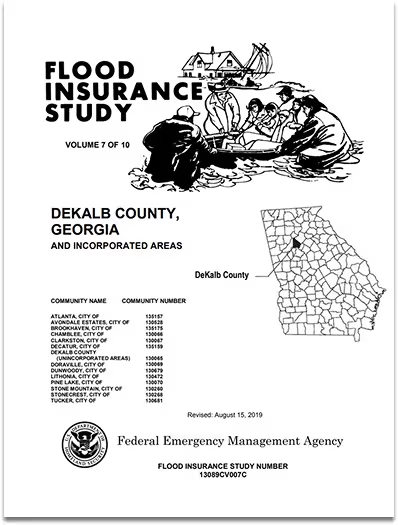
Flood Insurance Study - Volume 7
Flood Insurance Study - Volume 8
Hazard Mitigation
Hazard mitigation reduces long-term risks to life and property from future disasters. Common strategies include:
- Elevation – Raising a structure’s lowest floor above the regulated flood level
- Relocation – Moving a structure out of a high-risk flood area
- Demolition – Removing a damaged structure and rebuilding to current standards
- Floodproofing
- Dry Floodproofing: making structures watertight
- Wet Floodproofing: allowing floodwater to enter designated spaces
- Barrier Systems – Floodwalls or levees designed to hold back rising water
Flood Insurance Requirements
Flood insurance is required when:
- Your mortgage is federally regulated or issued by an insured lender
- Your property is in a high-risk flood zone
- You have received FEMA disaster grants or SBA disaster loans after a presidential declaration
Even if insurance is not required, all residents are encouraged to review Risk Rating 2.0 and understand their flood risk.
Hazard Mitigation Assistance Programs
FEMA offers several programs that support community resilience:
- Hazard Mitigation Grant Program (HMGP): Funds post-disaster mitigation planning and projects
- Flood Mitigation Assistance (FMA): Supports mitigation projects for NFIP-insured structures
- Building Resilient Infrastructure and Communities (BRIC): Invests in infrastructure resilience
DeKalb County Home Buyout Program
- Voluntary FEMA-funded relocation from flood-prone areas
- 75% federal funding with a 25% local match
- Purchased properties become permanent open space