


Noise Program

The DeKalb-Peachtree Airport Noise Program is dedicated to balancing the operational needs of one of the nation’s busiest general aviation airports with the quality of life of surrounding communities.
Through monitoring, reporting, and community engagement, the program works to address noise concerns, promote voluntary compliance with noise abatement procedures, and provide residents with tools to share feedback. By fostering collaboration between the airport, pilots, and neighbors, PDK strives to operate as a responsible community partner while supporting safe and efficient aviation activities.
File a Noise Complaint
Multiple convenient ways to report aircraft noise concerns. Please provide as much detail as possible including your address, date, time, and description of the noise event.
Email
Phone Hotline
Call 770-936-5442, our dedicated noise hotline, to report complaints by phone. The hotline is not answered by a live person.
Noise Abatement Program
Important Notice: Due to Federal Law (Airport Noise and Capacity Act), PDK cannot adopt new noise rules or restrict aircraft access. Only the FAA can enact operational restrictions to reduce aircraft noise.
Our comprehensive noise program includes multiple initiatives working together to minimize aircraft noise impact on surrounding communities.
- Preferential Runway Use - Strategic runway selection to minimize noise over residential areas
- Flight Procedures - Specialized noise abatement procedures for turbojet aircraft
- Voluntary Night Curfew - Encouraged quiet hours to reduce nighttime disturbances
- Noise Monitoring - Continuous monitoring and reporting of noise levels
- GPS Approaches - Off-set GPS instrument approaches to reduce noise impact
- Special Permissions - Prior permission required for heavy aircraft and military operations
Noise & Operations Reports
Monthly reports presented to the Airport Advisory Board, posted following each meeting.
- 2026 Monthly Reports - Jan, Feb, Mar, Apr, May, June, July
- 2025 Monthly Reports
- 2024 Monthly Reports
- 2023 Monthly Reports
- 2022 Monthly Reports
- 2021 Monthly Reports
- 2020 Monthly Reports
- 2024-2016 Annual Reports - Complete year summaries
- Noise Contour Map - 2016 noise impact mapping
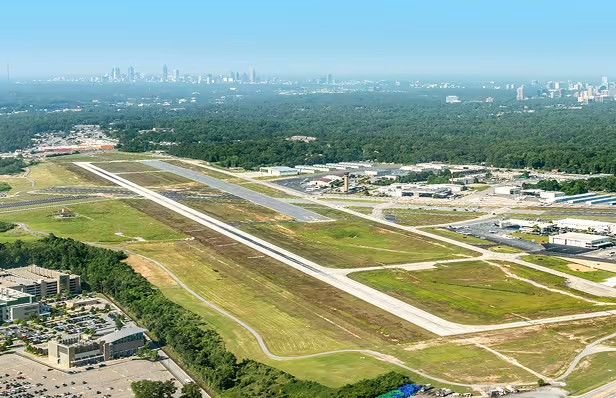
Frequently Asked Questions about PDK and Noise
Q. Why do planes fly over my house?
A. The Atlanta metro area has several airports – including Hartsfield-Jackson International, Gwinnett’s Briscoe Field, Cobb’s McCollum Field, Peachtree-Falcon Field, and Fulton County’s Charlie Brown – plus many smaller ones. The FAA manages airspace for the entire region, so flights occur over all areas. Aircraft are most frequent near airports and their flight paths.
Q. Are planes flying over my house on purpose?
A. No. Pilots follow set routes and do not single out specific homes. At normal altitudes, they cannot see individual houses or yards.
Q. Why don’t aircraft owners replace noisy jets?
A. Most jets at PDK weigh under 75,000 pounds, which are not subject to federal “hushkit” requirements. Heavier aircraft must meet Stage 3 noise standards, the quietest technology currently available. Owners typically upgrade aircraft when it makes financial sense, similar to car owners trading for newer models.
Q. Why do planes sometimes take off south when there’s no wind?
A. Pilots prefer to take off and land into the wind, but airport conditions can differ from nearby neighborhoods due to open terrain. In addition, PDK’s instrument approach requires southbound landings, which means departures must also flow south for safety.
Q. Why can’t southbound planes climb higher or turn later to avoid neighborhoods?
A. Air traffic patterns are set by the FAA. South of PDK, airspace is limited by Hartsfield-Jackson’s operations, other nearby airports, and tall radio towers. To remain safe and compliant, aircraft must turn east or west shortly after takeoff.
Q. Who handles low-flying aircraft complaints?
A. The FAA’s Flight Standards District Office (FSDO) investigates low or unsafe flying. Call 404-305-7200 to report. PDK does not control aircraft once airborne.
Q. Has PDK changed its flight patterns?
A. No. The FAA manages all air traffic at PDK. Flight paths may temporarily shift due to wind, weather, or efforts to route aircraft over major roads and rail lines, but overall patterns have not been permanently changed.
Q. Why does PDK have a voluntary nighttime curfew?
A. As a public-use airport, PDK cannot legally restrict hours or deny access to specific users. Instead, the airport promotes a voluntary curfew published in pilot references and noise abatement materials. Some essential flights (medical, law enforcement, deliveries) must still operate at night, but PDK works with operators to minimize noise whenever possible.
Q. Why wasn’t I told I live near an airport?
A. DeKalb County does not require sellers or realtors to disclose proximity to airports. It is the buyer’s responsibility to research the area before purchasing.
Q. What causes aircraft noise?
A. Noise is most noticeable during takeoff, when high-pressure jet exhaust meets cooler outside air. Modern Stage 3 engines reduce this by slowing exhaust and using sound-absorbing materials.
Q. What other factors affect aircraft noise?
- Weather: Clouds and thermal layers can amplify sound.
- Storms: Aircraft may divert from normal routes.
- Airspace Limits: Nearby airports constrain flight paths.
- Emergencies: May require unusual routes or extra approaches.
- Aircraft Weight: Heavier planes climb slower, keeping noise closer to the ground.
Q. Do bigger planes always mean more noise?
A. Not anymore. All aircraft over 75,000 pounds must be Stage 3 compliant, making newer large jets quieter than many older, smaller planes. In fact, older light aircraft are often the noisiest.
Noise Information & Complaints
Consultations
Questions about flight tracks near your home? Contact the Noise Information Office at 770-936-5440 or email to schedule a consultation with the Airport Noise & Environmental Analyst.
Noise Complaint Hotline
Call 770-936-5442. Please provide:
- Type of aircraft (jet, prop, or helicopter)
- Your address
- Date and time of event
- Whether you would like a call back
Reports
Review Monthly and Annual Noise Reports to track airport noise trends.
PDK Noise Office Contact
- Email: pdknoise@dekalbcountyga.gov
- Phone: 770-936-5442
For questions about aircraft noise, moving near PDK, or our noise abatement programs.
Moving Near PDK
Thinking of moving to Brookhaven, Chamblee, Doraville, Dunwoody, or other DeKalb County communities? Living near Georgia’s second-busiest airport comes with many benefits, but also the reality of aircraft noise. The impact of noise varies by location and is often subjective. Below are resources to help you understand PDK operations and what it means for nearby neighborhoods.
Neighborhoods Near PDK
Brookhaven
Ashford Park, Blackburn Park, Briarwood Park, Brookhaven Heights, Brookhaven Village, Drew Valley, Hillsdale, Historic Brookhaven, Lenox Park, Lynwood Park, Murphy Candler Park, North Brookhaven, Nancy Creek, Pine Hills, Town Brookhaven
Chamblee
Appling Heights, Beverly Hills/Woods, Clairmont Park, Dresden Square, Frontier Woods, Gainsborough, Huntley Hills, Keswick Village, LaVenture Forest, Marlin Acres, Mendenhall, Sexton
Doraville
Embry Crossing, Fleetwood Hills, Fountainebleau Forest, Gordon Hills/Heights, Honeysuckle Park, Northcrest, Northwoods, Pleasantdale, Sequoyah Woods, Winters Chapel
Dunwoody
Ashford Chase, Ashworth, Briers North, Dunwoody Club, Dunwoody Village, Lockridge Forest, Meadowlake, Mount Vernon, Wintercrest, Wyntercreek
Learn About Flight Operations
- Typical Flight Tracks: Interested in learning about the typical aircraft flight tracks over a potential house or neighborhood? Contact PDK's Noise Information office by email, or call 770-936-5440 and ask to speak with the Airport Noise & EnvironmeRntal Analyst to set up a consultation.
- Noise Contour Map: Shows FAA’s 65 DNL (Day-Night Average Sound Level) boundary, the threshold for significant aircraft noise impact.