


Watershed Management
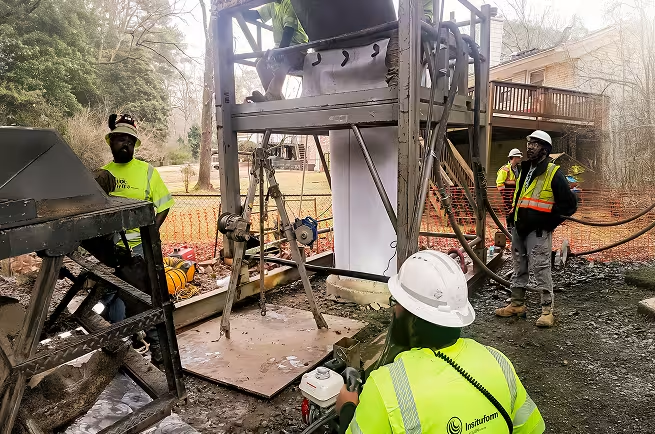
The DeKalb County Department of Watershed Management is dedicated to protecting public health and the environment by delivering safe, reliable water and wastewater services to our community.
This section provides access to information about water quality, billing and customer programs, infrastructure maintenance, emergency services, and long-term planning efforts that support a sustainable water system. Through responsible stewardship and responsive service, the Department works to ensure clean water resources and resilient infrastructure for residents, businesses, and visitors across DeKalb County.
Leadership
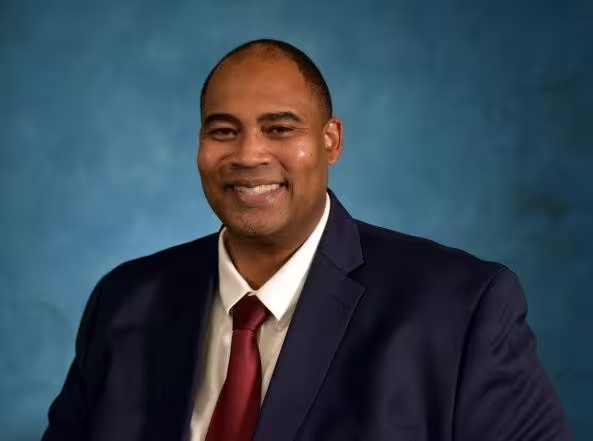
Director Reginald Wells
Reginald Wells is an executive level, solution-oriented civil engineer with over 25 years of combined service in both the public and private sector. He has served as a civil engineer on water resource program management teams, site design projects, and various transportation projects.
Reginald possesses a unique blend of heightened analytical, communication and interpersonal skills with demonstrated leadership and operational expertise. He has demonstrated success at providing the vision and leadership for high-performance construction and maintenance operations for large-scale water utilities with asset value up to $8 billion and $650 million in annual revenues. Reginald has proven to be an exceptional decision maker during stressful emergency situations with a sound track record of mitigating severe service interruptions and system failures.
In addition to being proficient at establishing operational excellence within culturally diverse environments and nontraditional business settings, he is also well versed at leading complicated strategic organizational change while optimizing operational staff and increasing service delivery.
As the director of Watershed Management for DeKalb County, Reginald serves as a member of the County’s CEO’s senior leadership team. He is responsible for the County’s water and wastewater operations producing potable water, treatment and disposal of wastewater including an estimated 5,000 miles of water distribution and sanitary sewer collection piping. The facilities managed under his purview includes the Scott Candler Water Filter Plant and associated water storage tanks and booster pump stations, the Pole Bridge Advanced Wastewater Treatment Plant, the Snapfinger Advanced Wastewater Treatment Plant and 67 lift stations. The Watershed Management Department has a budget of $300 million, a workforce of 700 employees providing services to a population of approximately 800,000 residents.
Prior to rejoining DeKalb Watershed in 2025, Reginald was previously with the City of Atlanta’s Department of Watershed Management for over 16 years in several leadership roles. He last served as Assistant Commissioner of Department of Watershed Management where he provided executive leadership for all operational divisions within the department. Responsible for oversight of the Department’s dedicated workforce of over 1,350 employees, a $675 million annual operating budget, a five-year capital improvement plan of $1.2 billion, including the Water Supply Program, the nearly $4 billion Clean Water Atlanta Consent Decree Program aimed at the elimination of sanitary sewer overflows, and overall compliance with two Federal Consent Decrees (CSO and SSO).
Reginald is a current member of the Georgia Association of Water Professionals, American Water Works Association, National Association of Clean Water Agencies and the American Public Works Association.
Deputy Directors
Lynette Ferguson – Water Metering & Field Services
Georginna Lockett – Operations
Michelle Thorns – Finance Administration
Kerry Williams - Engineering & Construction Management Services
Department Contact Info (call or email anytime)
(770) 270-6243 | dekalbwaterops@dekalbcountyga.gov
Hours of Operations
Open - 24 Hours / 7 Days
Clean Water, Strong Community
Serving DeKalb County since 1942 with reliable water and wastewater services.
Mission Statement
Department of Watershed Management (DWM) is dedicated to providing safe, reliable, and premium
water and wastewater services in the most cost-effective manner to all our customers throughout
DeKalb County.
DWM executes its mission through the following functions:
- Provide water and sewer service to 775,000+ DeKalb County residents
- Produce up to 150 Million Gallons Per Day (MGD) finished water/day
- Distribute 75 MGD/day of safe drinking water
- Maintain 5,200 miles of water distribution and sanitary sewer piping network
- Treat a combined 32 MGD treated wastewater /day
- Maintain meters for over 200,000 customer accounts
Goals
- Customer Service
- Financial Viability
- Organizational Best Practices
- Reliable and Resilient Infrastructure
- Employee Development
- Collaborative Partnerships
Quick Actions
- Pay Your Bill
- 24-Hour Emergency Line: 770-270-6243
- Apply for New Service
- Current 2026 Rates
Key Statistics
- 5,200+ miles of water and wastewater pipes
- Serving 775,000+ residents
- 3 Major treatment facilities (1 Drinking and 2 Waste)
Contact & Support
Customer Service
- Billing Questions: 404-378-4475
- General Information: 404-371-2667
- Emergencies: 770-270-6243
- Main Office: 4572 Memorial Drive, Suite 200, Decatur, GA 30032
- Engineering Office: 180 Sams Street, Decatur, GA 30030
- Hours: Monday-Friday, 8:00 AM-5:00 PM
Online Services

